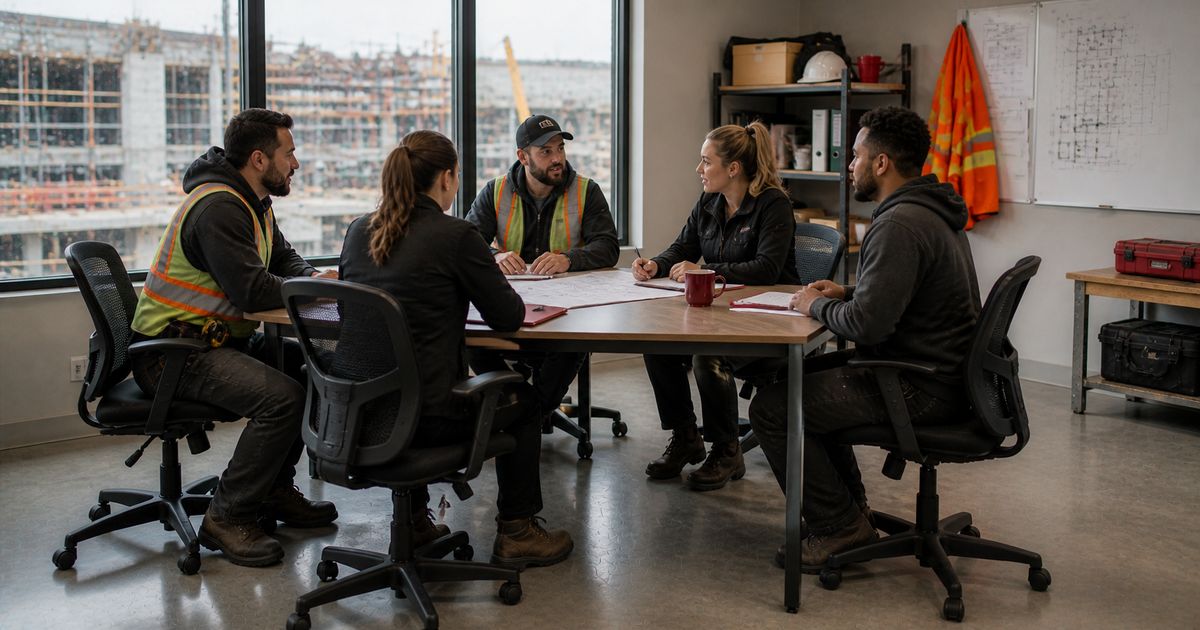
Job interviews in 2026 look different from what many skilled trades workers remember from even a few years back. AI screening tools, video platforms, and shifting employer expectations have reshaped how hiring decisions get made, so updating your preparation strategy is no longer optional. Whether you are applying for a journeyperson electrician role in Alberta or a millwright position in Ontario, these interview tips for 2026 will help you walk in confident and walk out with an offer.
Quick takeaways
- AI screening tools now review resumes and sometimes video responses before a human recruiter sees your application
- Virtual interviews are standard across many trades sectors in Canada
- Behavioural questions are the dominant format; knowing the best way to answer interview questions requires structured practice
- Mock interviews and recorded run-throughs are the best way to practice interview questions and reduce anxiety
- Trades workers who research the employer and know their certifications cold stand out consistently
How Canadian Hiring Has Shifted for Skilled Trades in 2026
Canada's skilled trades market remains one of the country's strongest employment sectors, with sustained demand for certified workers across construction, manufacturing, industrial maintenance, and infrastructure. But the hiring process itself has modernized, and job seekers still using techniques from five years ago are leaving opportunities on the table.
What Employers Are Looking For Beyond Technical Credentials
Employers across the trades sector are looking beyond your Red Seal endorsement or provincial certificate. They want workers who communicate clearly, adapt to evolving safety protocols, and back up claims of reliability with documented examples from their work history. Soft skills, once treated as secondary to technical competence, now get explicit attention during structured interviews at companies of all sizes.
The Rise of Structured Interviews
More employers, including large contractors, Crown corporations, and municipalities, are adopting structured interviews: a standardized set of questions asked to every candidate in the same order, scored against a rubric. If you have had an interview feel formal and almost scripted, this is likely why. The upside is that structured interviews are highly predictable, which makes your preparation more efficient.
Certifications and Compliance Documentation
In structured or panel interviews, expect direct questions about your Red Seal endorsement, provincial trade certificates, and current safety training such as Working at Heights, WHMIS 2018, and any equipment-specific licences. Have your certification dates memorized and bring physical or digital copies to every interview. Employers in regulated trades treat documentation gaps as disqualifying.
AI-Assisted Screening: What to Expect Before You Even Meet a Human
One of the most significant changes shaping interview tips for 2026 is the normalization of AI-assisted screening. Many mid-sized and large employers now use software to pre-filter applications and, in some cases, to conduct one-way video interviews before any live conversation takes place.
How AI Resume Screening Works
Applicant tracking systems parse your resume for keywords that match the job posting. If your resume does not contain the right terms, it may be filtered out before a human reads it. Use the exact language from the job posting when describing your experience. If the posting says "preventive maintenance," do not write only "PM work." Mirror the terminology used by the employer without stuffing your resume with unnatural repetition.
One-Way Video Interviews
Some employers in utilities, facilities management, and large construction firms are now sending candidates a link to record answers to three to five questions. You record on your own time and the employer reviews recordings later, sometimes with the assistance of AI analysis tools that assess word choice, structure, and delivery.
To handle these well:
- Set up in a quiet, well-lit space with a neutral background
- Dress as you would for an in-person interview
- Speak directly to the camera, not to your own image on screen
- Keep answers focused: aim for 90 to 120 seconds per question
- Do a test recording before submitting to verify your audio quality and framing
What AI Screening Is and Is Not Looking For
AI screening tools are not assessing your personality the way a human interviewer might. They evaluate clarity, structure, and relevant content. If you stay on topic, use plain language, and directly answer what was asked, you will score well. Overthinking how you "come across" is less useful than making sure your answer actually addresses the question.
Virtual Interview Best Practices That Actually Work
Video interviews are now standard across a wide range of hiring contexts, from initial screening calls to final panel interviews with hiring committees. Getting comfortable with the format is one of the most practical interview tips for 2026, and it requires deliberate setup, not just logging on.
Setting Up Your Environment
Your physical environment matters as much as what you say. A cluttered background, poor lighting, or an unstable internet connection will undercut a strong answer.
- Use a wired internet connection or sit close to your router during the call
- Face a window or use a lamp positioned in front of you so your face is well-lit
- Choose a plain, tidy background or a neutral wall
- Silence your phone and close unnecessary browser tabs and applications before joining
Camera Presence and Body Language
On video, small habits become more visible than they would be in a room.
- Position your camera at eye level rather than looking down at a laptop on a low desk
- Maintain eye contact by looking at the camera, not at your own thumbnail on screen
- Sit up straight and keep your hands in frame occasionally to reinforce engagement
- Avoid swiveling in your chair or fidgeting with objects on the desk
Technical Backup Plans
Have a backup plan before every virtual interview. Write down the interviewer's phone number in advance. If the platform crashes mid-interview, you can call immediately without scrambling through emails under pressure. Keep your phone charged and within reach.
The Best Way to Answer Interview Questions in 2026
Behavioural questions are the dominant format in 2026 interviews across most sectors, including skilled trades. These questions open with phrases like "Tell me about a time when" or "Describe a situation where you had to." The best way to answer interview questions of this type is to use a clear structure that keeps your response focused and relevant from the first sentence.
Using the STAR Method
STAR stands for Situation, Task, Action, and Result. It is the most widely used interview framework because it forces you to give a complete answer without rambling or circling back.
- Situation: Briefly set the scene. Where were you working, and what was the context?
- Task: What were you responsible for in that situation?
- Action: What specific steps did you take? Focus on what you personally did.
- Result: What happened because of your actions? Quantify the outcome where possible.
For example, if asked about a time you identified a safety hazard, describe the job site, your role, the specific hazard you spotted and how you spotted it, the steps you took to address it, and the outcome, including whether an incident was prevented.
Adapting STAR to Trades Contexts
Trades workers often undersell their experience because the work is physical and can feel self-explanatory. It is not. Use STAR to surface the complexity of what you do: tight project timelines, coordinating with other trades on a busy site, working through inspection deadlines, troubleshooting equipment failures under pressure. These are exactly the stories an employer wants to evaluate.
Core Themes to Prepare Stories For
Even without knowing the exact questions, these themes appear in nearly every trades interview:
- A time you resolved a conflict with a coworker, supervisor, or subcontractor
- A situation where you worked under pressure or a compressed deadline
- A time you identified and corrected an error before it became a larger problem
- How you approach a task or piece of equipment you have not worked with before
- A time you went beyond the minimum required to complete a job safely or correctly
The Best Way to Practice Interview Questions Before Your Interview
Knowing interview technique in theory and being able to deliver it under pressure are different skills. The best way to practice interview questions is to rehearse out loud, with another person when possible, in conditions that simulate the real thing.
Mock Interviews
Ask a friend, family member, or mentor to run a mock interview with you. Give them a list of common behavioural questions and ask them to push back with follow-up questions. Record the session and watch it back. What you notice about your own pace, filler words, and delivery will be more useful than any advice someone else gives you.
Practicing on Video Alone
If you cannot find a practice partner, record yourself answering questions on your phone or laptop. Watch for habits you may not be aware of: looking down too often, rushing through the end of an answer, or over-using filler phrases. One or two sessions of this kind of self-review will sharpen your delivery noticeably.
Writing Out Key Stories in Advance
Before the interview, write two to three bullet points for each of your strongest work stories. You do not need a memorized script. You need to know the key facts well enough that you can tell the story naturally even when nervous. Focus on the Action and Result sections of STAR, since those are where most people rush or go vague.
Using Job Postings to Guide Your Preparation
Browse active trades job postings on SkilledTradeJobs.ca to understand what qualifications and competencies employers in your trade are currently emphasizing. The language employers use in those postings gives you a direct signal about which skills to highlight and which questions to prepare for, even if you are not applying to those specific roles.
Research and Pre-Interview Preparation That Sets You Apart
Candidates who know something about the employer before they walk in stand out consistently from those who do not. This matters especially when an interviewer is seeing multiple candidates in a single day and looking for a reason to move one file to the top of the pile.
Researching the Employer
Look up the company on their website and check for recent news mentions or project announcements. For construction companies and contractors, look for recent bids, completions, or sector expansions. Know their primary sectors, whether commercial, industrial, residential, or infrastructure, and arrive with at least one question that reflects that knowledge. It signals genuine interest.
Understanding the Role Against Your Own History
Read the job posting carefully and map your experience to each listed requirement before the interview. If the posting asks for experience with a specific type of equipment or familiarity with a particular code or standard, prepare a STAR story that demonstrates that experience directly rather than mentioning it in passing.
Questions to Ask the Interviewer
Asking strong questions at the end of an interview signals genuine engagement and helps you evaluate whether the role is actually a fit.
- What does a typical first month look like for someone stepping into this role?
- How would you describe the safety culture on your job sites?
- Is there opportunity for additional certifications or trade training through the company?
- What is the team composition I would be working with most directly?
FAQ
Q: Do interview tips for 2026 differ significantly from previous years?
Yes, in several meaningful ways. AI screening tools are more widely used at the application and early interview stages. Video interviews are standard rather than occasional. Employers are placing greater and more explicit weight on behavioural competencies alongside technical qualifications. Updating your preparation to reflect these shifts gives you a real advantage over candidates relying on older approaches.
Q: What is the best way to answer interview questions that are behavioural in format?
Use the STAR method: Situation, Task, Action, Result. Focus your answer on what you personally did rather than what your team generally did. Keep each answer between 90 seconds and two minutes, end with a specific result tied to your actions, and resist the urge to add more detail after you have reached a natural conclusion.
Q: How do I prepare for an AI-scored one-way video interview?
Treat it like a live interview in terms of environment and attire. Speak clearly, address exactly what the question asks, and structure each answer so it has a clear beginning, a concrete middle that describes your actions, and a defined result. Do a practice recording first to confirm your audio, lighting, and framing before submitting your actual responses.
Q: What are the most common interview questions for trades workers in Canada?
Expect questions about your specific certifications and their currency, your approach to on-site safety and relevant codes, examples of problem-solving under time pressure, how you handle disagreements with coworkers or supervisors, and your experience with equipment or systems listed in the job posting. Prepare at least one concrete STAR story for each of these themes.
Q: How far in advance should I start preparing for a job interview?
Start as soon as you receive the invitation. Even two to three days of focused preparation, which includes reviewing your work history for strong STAR stories, researching the employer, doing one recorded practice run, and confirming your tech setup for a video interview, makes a measurable difference in how clearly and confidently you come across.
Q: Where can I find current trades job postings to understand what employers are looking for?
SkilledTradeJobs.ca lists active skilled trades job postings across Canada. Reading through current postings in your trade is one of the most direct ways to understand what employers are emphasizing right now and to tailor your interview preparation to match.
Your Next Move Starts Here
Preparing for a 2026 job interview means understanding AI screening, mastering the virtual format, and being ready to deliver clear, specific answers to behavioural questions with real examples from your work history. The fundamentals of a strong interview have not changed, but the context around them has, and trades workers who update their approach have a genuine edge over those who do not. Ready to take the next step? Visit skilledtradejobs.ca to explore job opportunities.